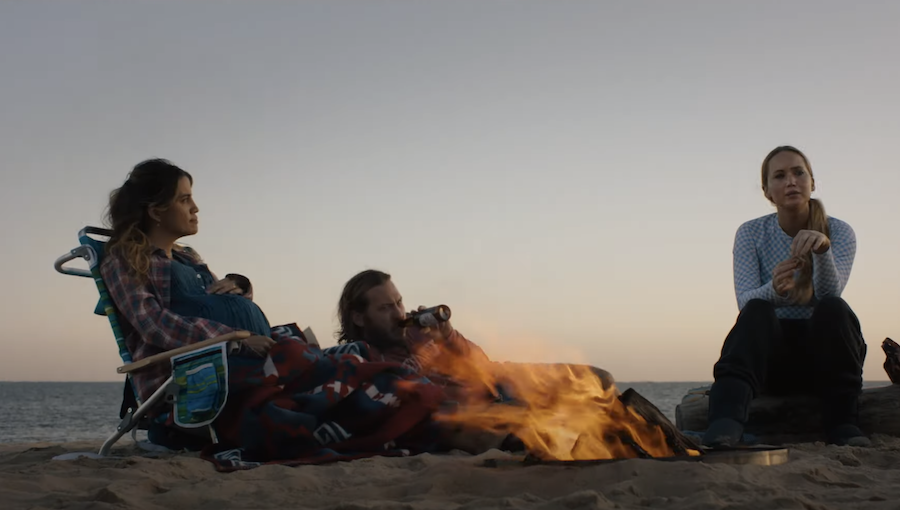
historyofdevil3 The Devil has one overriding desire—to get back into Heaven—and he has set up a trial in Kenya for that purpose. If found not guilty of inflicting suffering on humanity (or something like that), he gets back in; if found guilty, it’s the status quo.

You might be surprised at how completely those two simple sentences synopsize the plot engine of Clive Barker’s The History of the Devil. But Barker is not especially concerned with plot; instead, this seems to be about holding forth on the nature of evil and of humanity, and musing on whether the former isn’t wholly a product of the latter. (We even get the following bit near play’s end: “Doesn’t [the Devil] look, in his confusion, in his cowardice […] a little like us?”)

Thus begins the “bad news” portion of this review, which is about the script. (A “good news” portion of the review immediately follows.)

[ Bad News: The Script  ]

Even if all Barker’s holding forth—or pontificating, one could be excused for feeling—were consistently substantial and grew naturally out of the action, I’m not entirely sure it would work, considering how much there is. So as it is . . .

Never mind that, though, because some people might find Barker’s thoughts on these matters more compelling than I do. What shocked me a bit is Barker’s either not noticing or minding that his script is full of inconsistencies and places where the logic of his play’s universe often lack internal coherence. It would be a major spoiler to explain here how the entire framing of the trial makes no sense whatsoever, but I can offer a few of other examples of the type of problem I have in mind:

  • Why didn’t Barker settle on a date for when Lucifer first fell from Heaven? It’s a minor point, but Barker goes out of his way to toss around various timeframes—5,000 years ago, 10,000 years ago, some olden time since the creation of Russia, and some time much longer ago than any of these, to name four I can recall explicitly—all of which conflict. Curiously, Barker unintentionally implies throughout that Lucifer’s fall was post-Edenic (there is explicit reference to Eden as a historical fact: the trial occurs “60 miles from Eden.” Why there and not, say, on the exact spot? I haven’t the foggiest), which doesn’t comport with any of the mythology he’s appropriating.
  • Why is the Devil’s mind-reading ability inconsistent? For no reason I can fathom, Barker’s Lucifer is a mind-reader—but only at surface level (whatever that means). And, as it inexplicably turns out, only some of the time. Because at the very climax of the play, the Devil is completely blindsided by someone intentionally engaging in major duplicity—someone with no knowledge of his mind-reading ability, and so no motivation to try mentally to conceal the duplicity in question.
  • Why do all the characters in the play except one, no matter what time or place they’re from, speak English? Understand, I’m not talking about the actors, nor would I be asking this question if the magic of the trail had everyone conversing in an ad hoc lingua franca. That may fly for the flashbacks, but back in present-day Kenya, Barker makes it explicit that everyone in the play is speaking English—except Dante, who runs on stage speaking Italian, which has to be translated (by an American lawyer who just so happens to be fluent, I guess) into English. (Though Dante magically breaks into English for a few lines. God knows where he picked that up.)

The Dante incident exemplifies another sort of problem with the script, which I’ll call Barker ex machina: much of what happens is random, save that it affords Barker a chance to drop some pith on us. It’s completely puzzling why Dante is present, except that it gives the Devil a chance to say that the real reason Dante’s so pissed off is because the universe is naturalistic and not moralistic.

I gotta be honest: I could go on in this vein, because this is a play that clocks in at about three-and-a-half hours, and problems are spread throughout. But let’s get to that good news.

[ Good News, in Three Parts ]

Two aspects of the Garage’s production really stand out. Thankfully, one of those is Angel Correa in the title role. He enters appearing every bit an upbeat version of The Matrix‘s Morpheus, and the relish with which he plays the Devil never flags. It’s not all tongue-flicking sadism and salaciousness—though there’s plenty of that, all of it good—but there’s childish petulance, frustrated desire, wariness and confusion, even moments of self-doubt. Correa is believable and fun, and that gives us something to cling to even when Barker is off the rails.

The other standout is Andrew Pedroza in the meatiest of his four roles—Jesus Christ, himself. Pedroza’s Christ is kind of a nutjob, an out-of-his-mind ascetic with visions of his own grandeur (justified, as it turns out). When the Devil encounters Christ during the latter’s 40 days in the wilderness, that’s some funny shit, both because the actors are up to the frenetic paces that director M.S. Cliff E. Threadgold puts them through, and because this is probably Barker’s best moment, combining the clever and the wacky while sparing us the would-be gravitas.

The Garage also does a nice job with getting us to suspend disbelief as we flashback to a particular time and place. With a minimalistic set design and simple lighting cues, we have no problem jumping between the trial and ancient Greece, late 18th-century England, a WWII battlefield, etc. The History of the Devil is a sort of epic, and while I could see Hollywood blowing $100 million on a film version, on a shoestring the Garage does enough to get across the epical nature of the script.

I attended a preview performance of The History of the Devil, and what I hope for run of the show is that the cast will continually push their characters over the top, using adrenaline to red-line the show. This flawed script can serve as a vehicle to give the audience a good time via performance—and the Garage peeps are quite capable of doing just that. Show the see after you’ve had a few drinks. The more rollicking and devil-may-care cast and audience are, the better for everyone. 

THE HISTORY OF THE DEVIL THE GARAGE THEATRE • 251 E 7TH ST (JUST OFF LONG BEACH BLVD) • LONG BEACH 90813 • 562.433.8337 THEGARAGETHEATRE.ORG • THURS-SAT 8PM • $20; $18; $15 FOR TEACHERS, STUDENTS, AND SENIORS. ALL THURSDAYS ARE “TWOFER SUTHERLAND”: 2-FOR-1 TIX • THROUGH OCT 30TH