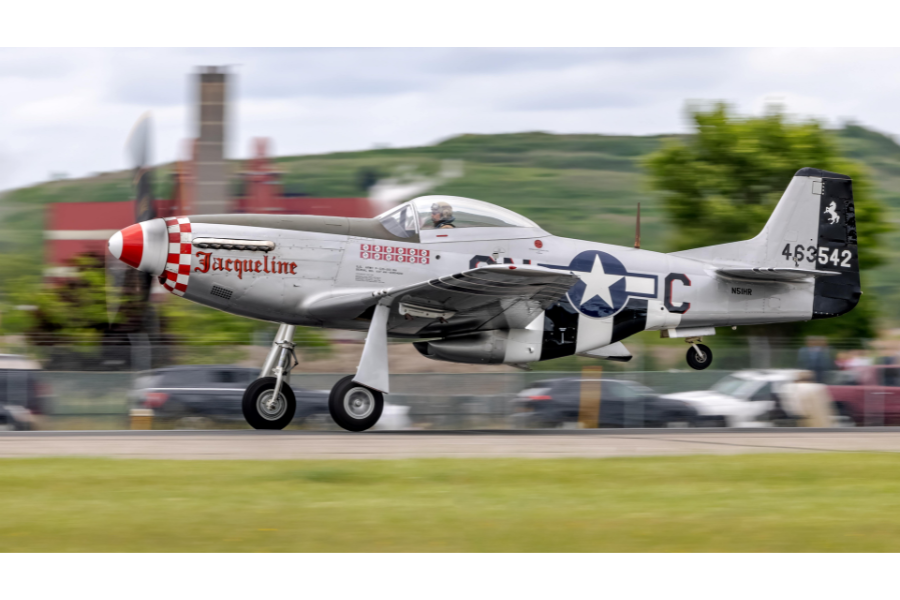
MCDNOBY EC002 The Airplane Owners and Pilots Association—AOPA, for short, and pronounced pretty much the way it looks: A-O-Puh—has flown into Long Beach for its annual three-day convention, mostly in the smallish private planes of a bunch of rather rich, old, white dudes whose telephone ringtones are no doubt “Highway to the Danger Zone.”

Not that you have to own a plane or possess a pilot’s license—or even aspire to, someday—to attend the long and varied schedule of AOPA meetings and events. Thankfully, you don’t even have to particularly like Top Gun. They’ll let anybody in.

So it turned out to be a good decision not to try to blend in with the AOPA conventioneers by wearing an old flight suit, aviator goggles and a scarf—or even some pin-on wings that might have been given to me by a kindly commercial pilot during some flight I might have taken as a child … you know, if I’d ever flown anywhere east of Nevada. It probably also spared me some problems on the bus ride to the Long Beach Convention Center…you know, since I own as many cars as planes and my driver license is as valid as my pilot’s license.

I wouldn’t exactly say I infiltrated this world all too effectively. I have no doubt I looked as out of place as a balsa wood, rubber-band-propellered model plane in a World War II bombing run. Nonetheless, by the time my day at AOPA was over and I was on the bus home again, I had rubbed elbows with ATCs, talked at length about IFR vs. VFR and learned how the inefficiency of the NTSB often leaves people who want to know the cause of crashes SOL.

Oh, excuse me, I’m sorry—this must all sound so foreign to those of you who don’t know any air traffic controllers, have never discussed the pros and cons of instrument flight rules vs. visual flight rules or bemoaned how the National Transportation Safety Board’s investigation of crashes so often leaves us Shit Outta Luck.

But my day at AOPA was a pretty effective crash-course in aviation, and that isn’t as bad a choice of words as you might think, since the first seminar I attended was simply titled “What Went Wrong?” Of course, since I arrived 15 minutes late, I first had to figure out, “What Was Going On?’

I pieced together the group’s discussion pretty quickly: Apparently, a man had been flying a small plane in Alaska, but something had gone wrong—and he crashed. The presenter analyzed each part of the flight’s info and walked the group through possible scenarios of what may have caused the crash.

It was pretty much like any college lecture I had attended during my just-completed four years at Long Beach State. The logic was easy to follow most of the time, and there were a bunch of people who thought they were smarter than everyone else and tried to prove it by posing long, in-depth questions for which the presenter really didn’t have an answer.

There was also pilot humor, and at one point everyone laughed at something. I didn’t.

Though obviously still lost in this crowd, I began to play along with all the plane owners. As the speaker detailed the crashed plane’s cockpit, it struck me that the instrumentation seemed extensive, that perhaps it was overkill.

And when the speaker posed the question—“So what could be the problem with all of this instrumentation?”—I found myself almost leaping out of my seat as I raised my hand to answer. I was sure, almost, that the pilot probably had information overload and was so distracted by all of his gauges that he had crashed into the mountains of Alaska.

The speaker called on someone else, but it turned out I had the right answer. I was getting the hang of this flying thing.

When “What Went Wrong?” was over, I headed down to the main hall of vendors and exhibitions. There was row after row after row of booths selling a vast array of the most peculiar and specific items.

I started asking questions. Answers were everywhere.

Jeff Dunn at Jeppesen gave me a 15-minute history lesson on Elrey Jeppesen—or as he lovingly referred to him, Jep—one of the innovators of flight mapping. I watched a demo of Jeppesen’s latest product, an interactive tablet that shows flight paths, airport layouts and the like. Cost: $1,195 … plus around $400 for each map you would need. It looked pretty impressive, but it was really just a black-and-white iPad that couldn’t play Tetris.

I walked up to the Scheyden precision eyewear booth and stated my business in no uncertain terms.

“I’m not a pilot, but I really want to look like one,” I told salesman Jeff Herhold.

Jeff informed me I had come to the right place, and even chose a few pair of glasses he thought would fit nicely with my face. They did look pretty good, but I wasn’t sure they were $250 good.

More booths. More questions. More expensive things I had no use for.

Then I laid my eyes on something that could actually be quite useful to me—a car that doubled as a plane! Considering I don’t own either, this seemed like the most logical purchase that I had encountered thus far at AOPA. For $250,000, the machine they call The Transition could be mine. Production is to begin in 2011; I guess the future is now.

I went on to learn about tactical hearing, the different options in floatation safety, aerospace insurance, the danger of ice buildup on long flights, the importance of non-polarized lenses in flight goggles, Amelia Earhart’s favorite bracelets and how I could go on a African Aero safari for only $800 a day.

Considering the uselessness of most of this information, it’s not surprising that things reached the point where I was choosing booths based on who was working them. That’s how I eventually ended up at the Smart Pac booth, which had by far the best looking attendant of the entire convention.

I talked at length with Eve Storm, vice-president of the Las Vegas-based company that specializes in portable lithium ion starting units for all sorts of vehicles. Smart Pacs are basically mobile jumper cables that can help start a dead battery when there are no other options. Peace of mind if you get in a bad situation. Or as Eve so eloquently summed things up: “When you have it, you don’t need it. But when you don’t have it, you’re fucked.”

She said I could quote her on that.

After about three hours, I decided to call it a day, but before I got back on the bus to head home, I took off my AOPA media badge and put it back in the navy blue tote bag I was given. I figured most of my fellow bus riders weren’t airplane owners or part of the pilots association, either.