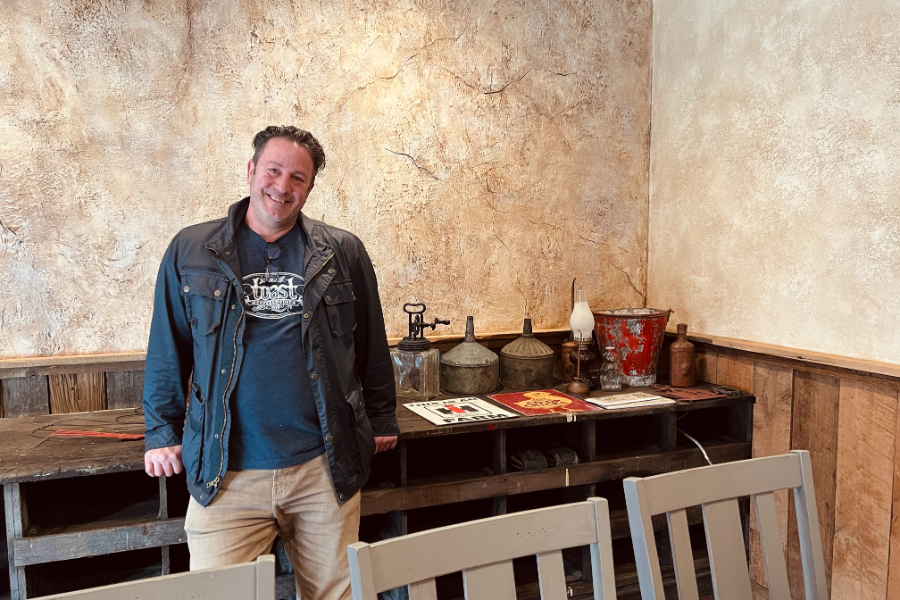
SHASHIN DESAI: THOUGHTS ON A LIFE IN—AND NOW OUT OF—THE THEATER
By Dave Wielenga
“I remember, as a kid, that I used to make plays in our back yard,” Shashin Desai says, his words taking on the vague strain that tends to seep into people’s voices when they are extracting their deepest memories. That fits. Desai is mining recollections from a time close to his artistic birth, not to mention a place on the other side of the earth—his native India. “I remember I would get all the neighborhood children to be in these plays,” he continues. “And I remember that we took it very seriously.”
Apparently, more seriously than the audiences which often gathered to watch these little productions—usually adults who were always dropping in to confer with Desai’s father, an educated man with a successful textile business and an influential passion for India’s growing movement for independence from Great Britain. “These adults used to stop what they were doing and watch us,” Desai recalls. “They were obviously amused.”
Desai wasn’t—and isn’t. Not that he doesn’t appreciate the charming and poignant scene that he and his playmates must have created with the earnest enthusiasm they brought to their early forays into the theater arts. All these years later, however, Desai wonders if those adults truly appreciated it. He’s not certain why they were amused. He’s slightly bothered that they might not have taken it seriously.
For his part, Desai is still moved by those backyard dramas … or perhaps more accurately, still moving. The plays he made with his young friends helped set his life in motion.
“What I am saying is, that had meaning,” Desai asserts, his voice back at full strength again, his brief reverie replaced by one of his enduring convictions. “It had the root of commitment. We had planted it and there was something going on—the ground was holding the root, nourishing it.
“Whatever that is, whatever you call it, wherever you find it—whether there are five people in the cast or five people in the audience—it is OK, it is perfect. Nothing else is an issue. The issue is how sincere people are.”
As the decades have passed, as Desai moved from India to England to USC to Long Beach, this perspective has continued to inform his approach to theater, to all the arts, to life itself. And as he makes another change in course this week—leaving the International City Theater that he founded 25 years ago toward a destination still unknown—it explains why he remains so lively and passionate and motivating. This is not a man who is ready to retire.
“I’m going to enjoy the morning, feel the sunshine,” Desai proclaims through a rattling laugh early on the day after his departure was officially announced—a midwinter weekend morning that is breaking exactly that way. “Then I’m going to make a bold attempt to seize the day full of different opportunities.”
*****
THE INTERNATIONAL CITY THEATRE OPENED its 26th season Friday night with a production of “Love Repeating: A Musical of Gertrude Stein”—its first season ever without Shashin Desai. That’s hard to imagine. Desai has been the company’s public face, artistic soul and hybrid engine since 1985, when he brought it to life in a 99-seat performance space on the Long Beach City College campus.
Looking back, ICT’s transformation into the city’s resident professional theater seems like destiny. Actually, it was an unsteady metamorphosis. What appears to have been a grand master plan was instead the way Desai approached each stage of the company’s development with the same philosophic formula—relentless passion and perseverance arbitrarily seasoned with measures of creative vision and blind luck.
Yes, luck.
How else does it happen that Beverly O’Neill, who was president of Long Beach City College, later became the mayor of Long Beach, where she invited Desai to move ICT into the city’s underused performing arts complex?
How else does it happen that Bob Foster, who was a Southern California Edison executive when Desai invited him to breakfast in Belmont Shore—then parlayed his company’s new downtown prominence into a successful request for $133,000 in corporate support—later followed O’Neill as mayor of Long Beach, where he not only advocates for ICT, but serves as auctioneer at an annual fundraiser?
“Yes, I would call it luck,” Desai acknowledges with a chuckle, although he’s not about to leave that admission out there alone. “But we also have had a lot of talented people over the years. And we never give up. The word ‘no’ is not in my book. Around the company we like to say, ‘The difficult we do right away, the impossible may take a little longer.’”
Besides, that kind of support didn’t come until after ICT had distinguished itself as talented and groundbreaking company … although that recognition arrived with what seems like unnatural speed, too—like, immediately.
How does it happen that Desai’s choice for the company’s first-ever production in 1986 was the world premier of “A Quiet End,” Robin Swados’ play about gay men dealing with AIDS?
“I didn’t understand AIDS,” Desai admits. “Nobody really did. It seemed everyone was suddenly in the middle of this epidemic, full of uncertainty and fear, and this was the first time anyone had dealt with the subject dramatically.”
Desai’s willingness to confront his own ignorance and apprehension with his faith in the explorative powers of the dramatic process turned out to resonate with audiences—in Long Beach and far beyond.
“The response was fantastic,” he recounts. “It attracted attention throughout the country and the world. Our theater instantly became known as a new theater of quality that was willing to be the first to take on difficult themes and controversial subjects.”
“A Quiet End” made a big splash, but what has enabled ICT to keep swimming over the years is a deft mixture of productions that not only challenge audiences but also treat them to unabashedly entertaining comedies, musicals and whodunits. Desai insists, however, that his choices for ICT productions have never been based on condescending or opportunistic strategizing. If anything, he says, the variety of a typical ICT season has often represented his self-indulgence.
“I never direct out of desperation—the sense that I must have a hit or a good response,” he asserts. “I wouldn’t do that, and I don’t think it would be successful, anyway. When I select the season’s play I have always chosen as if I would get to direct all of them, even though I can’t. When I do it that way, I know I will have a great season.
“I don’t need to guess what the audience would like. The idea is to take the hands of the community, hold them gently, take them in the direction of a new experience and let them enjoy it.”
******
THE ANNOUNCEMENT OF DESAI’S DEPARTURE from the International City Theatre caught most people by surprise, but the company’s board of directors has had more than a year to get used to the idea. Desai tipped them off in late 2009 during a day of retreat at the World Trade Center, among various seminars in which a facilitator led discussions about the state of the ICT, where people hoped to take it, how they intended to get there, what kind of commitment they felt.
It was a peculiarly conflicted time for the company. It was coming off its two most unsuccessful economic seasons—failing to balance the budget for only the third time; the other was the year after 9/11—while planning a celebration of its upcoming 25th anniversary. In the midst of that, Desai let it be known that he wasn’t planning to be around forever—and maybe not for very long.
“At some point, for the good of any company or organization, the founder has to step aside,” Desai says. “Otherwise, the group becomes identified with only one name. That’s not healthy. If I can be so selfish as to call this theater my legacy, well, if it goes away with me, then it’s not really a legacy—is it?”
At the same time, however, Desai agreed with the board that going away at this particular moment—on the cusp of ICT’s silver anniversary and a golden opportunity to get out of the red—probably wouldn’t be good timing.
“We temporarily tabled the issue,” he says, “to see how the economy was going to go, to see how the company was going to do, to celebrate our 25th anniversary season.”
Last month, with all that behind him, Desai revisited the subject of his departure.
“I went back to the executive committee,” he recounts, “and said, ‘Now I’m going to put it in writing.’”
And last week, when a press release from the International City Theater announced that Shashin Desai was stepping down as founding artistic director, the list of his accomplishments—right up there with the Los Angeles Drama Circle’s prestigious Margaret Harford Award for “Sustained Excellence in Theater”—included this sentence: “In December, ICT concluded its 25th Anniversary Season with a balanced budget…”
Desai is proud, and he laughs in agreement at the suggestion that tending to the financial side of theater during difficult economic times may be nearly as much an art as the acting, directing, lighting and sets.
“Being an artist does not give you the right to be in a deficit,” he says. “We have to be, first and foremost, responsible, not doing things that are beyond our capability to pay for. I don’t think you have to do War-and-Peace-sized productions. Stick to the gut of the play, do it very simply and do it well. If people want this art—getting involved in the magic of believing—they don’t care about the set. Besides, if they walk away singing the set, you are in trouble.”
Desai isn’t pretending that funding is not essential to a healthy artistic community. He’s frustrated that Long Beach government officials too rarely make decisions that recognize the connections between the arts and a healthy community at large. He realizes that ICT has it better than many arts groups, but he was reminded again by the company’s unbalanced-budget years of 2008 and 2009 that it’s a long way from secure.
“I can say that the growth of the ICT is because of the city’s commitment to the arts,” he begins. “But on the other side of the coin, the city has not officially taken a stand on the arts. They talk about it, but the end of that conversation always starts with, ‘Because of budget constraints …’ The city is always poor. They never have any money. They always complain.”
That’s become standard all the way up the governmental funding chain.
“I think state and federal governments are cornered, too. They are struggling to find money to survive,” Desai says. “I don’t think art is on their minds.”
That would leave … us?
“If you want to keep the light of art and education alive it has to be through the artists, individual citizens and small businesses,” says Desai, quickly emphasizing that he is not taking government leaders off the hook.
“They can support the arts morally by doing things that that do not require budget expenditures—like go to events or take a public posture that encourages public support, that says, ‘We are behind you,’” he says. “It’s like parents. How do poor parents raise children, make them responsible and successful? Money is not always the thing that makes things better.”
******
THE NEW ARTISTIC DIRECTOR of the International City Theater, the person representing the ideas and enthusiasm of a younger generation, who is going to take the company in unexpected and exciting directions … is caryn desai? Yep, the spells-her-name-in-lower-case woman who has spent the last two decades married to the old artistic director. This is new blood?
“It’s not my doing—it’s about the board of directors,” insists Desai-with-a-capital-D. “They just admire her. They approved her unanimously. Even if I said no, she is wrong for the job, they would not believe me.”
But Desai happens to think desai is perfect for the job—you know, after having spent pretty much every living moment with her, at work and at home, for the past 20 years. He’s aware some may perceive her promotion as nepotism, and he’s a little sensitive about it, but after a quick denial he responds to questions by shifting the conversation to her accomplishments.
“She has always stood on her own,” Desai says. “As a director, she has been in the national light. She was one of 50 theater executives to go to Stanford University for a special training. She has a Master of Fine Arts as a director, a diploma in fundraising, another in marketing. She has served as our general manager for 20 years. What else can she do without only being referred to as my wife?”
On the other hand, circumstances may arise in which desai may require the institutional knowledge of Desai—situations in which anybody else might be able to call upon the predecessor for information or advice.
“We’ve already planned for that,” Desai laughs. “If she really has a question, she will put it in a folder while she tries to solve it. And when we go out to dinner—we do that every two weeks—we can discuss it … that is, if she hasn’t already solved it.”
Meanwhile, Desai knows he may face moments when he struggles with his reflex to make decisions—or at least take a strong position—on issues of importance to the theater company he founded and tended since its inception.
“I am going to stay away,” he promises. “For the good of the company and for the good of caryn, I shouldn’t be around to say a word. I have told everybody, ‘Don’t call me unless you just want to say hi … and if you get a call from me, don’t take it.”


3 Comments
The reason the reins should be handed over to a younger local, is because they’re much more capable of making “mistakes,” and one of those “mistakes,” often wind up being creative. Handing it over to a primary paper-pusher, with the old guard around to keep the goldfish bowl nice and murky, will guarantee more of the same, and by that I mean “bland entertainment for gramma,” rather than a company that creatively challenges and inspires their local community. Uh… what are you smiling at, Long Beach Playhouse? Got something to say? No, you don’t.
In any case, when you hear a lot of “artistic” posturing on this subject, it often means nothing but someone primarily interested in power, asserting themselves towards the gentle bumkins, in the primary effort of trying to get it, keep it, or get more.
In this case, looks like somebody won the trifecta.
Frankly, I wouldn’t trust any “leader” who seems to be in denial of rote capitalization. It’s a sign of trouble.
Jason,
it sounds like you have some kind of axe to grind. Clearly you are not aware of the blood, sweat and tears it takes to run a company like ICT. Shashin and caryn have worked for years to bring excellence to the city of Long Beach. They have mentored young actors and professionals. The have spent countless hours in the education system sharing their love of the arts and inspiring young people to live their dreams.
If you think that working seven days a week, fundraising year in and year out ( when there are no funds) writing grants, sitting in board meetings, pouring over hundreds of plays each year, basically having no life other than the theatre is fun think again. People like caryn and Shashin do it because they believe in keeping the arts alive. You have to appeal to the audience. If it’s grandma’s then so be it. They have kept the theatre running for 25years.. Critics and audiences (not just grandma’s) have loved the award winning productions.
I for one have been enjoyed many productions at ICT and feel that it has been instrumental in putting Long Beach on the map.
I haven’t seen Desai since the mid-80′s when I was a theater student at LBCC, but I remember him fondly. I was in a summer repertory production of “Hair” and Desai made frequent visits to rehearsals and his comments and suggestions were priceless… but the best part was seeing his broad smile in the audience during a performance. Being part of something that made that man smile will be a memory I’ll cherish always. My stage is now the grand theater we call Corporate America… but the craft I learned in Desai’s shadow remains valid and very helpful to my life to this day.
Thank you, Shashin! I am forever in your debt!
Exit, stage left… June