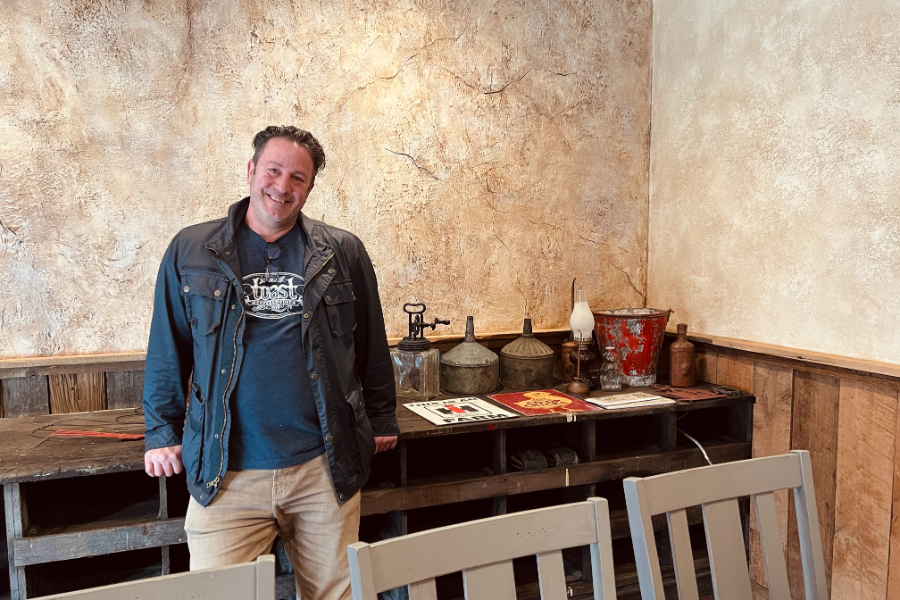
malmuthian The back story: The arrival of tonight’s (Feb. 26) Academy Awards reminds me that it was about this time last year that developer David Malmuth spent a big chunk of a sunny-and-breezy afternoon talking with me in the back of the cave-like bar at Hof’s Hut—the one on Long Beach Blvd, just over a high hedge from Virginia Country Club. At the time, Malmuth was getting ready for his second run at the Second+PCH project, a massive, mixed-use makeover of the low-slung Seaport Marina Hotel, armed with a second Environmental Impact Report, a revised support team and a new, rewrite-the-zoning-code strategy. He said he felt re-energized.  From California to the New York Island, this land (well, some very famous pieces of it, anyway) has been remade by Malmuth—for you and me, he’s always quick to insist.  Malmuth’s fanfare for the common man worked in Manhattan, where he helped restore the New Amsterdam Theater on 42nd Street, just off Times Square. It worked in Hollywood, where Malmuth developed kodaktheatre1 the Hollywood & Highland complex that has brought the Academy Awards back to their ancestral home. But Long Beach, doesn’t buy it—possibly because Long Beach is a city where the common man actually lives. Malmuth’s seemingly more attainable goal—to build a retail/residential/hotel complex on a corner currently occupied by a disintegrating hotel—was furiously opposed by environmental groups, many residents and other large potential developers. Last Dec. 20, the Second+PCH project was rejected by the City Council, 5-3. After blowing nearly four years of his career on cajoling, a reported $4 million of property owner Raymond Lin’s money, who knows how much on City staff’s taxpayer-funded time and two  Environmental Impact Reports, Malmuth is stuck on stupefied … again. Yes, again. Twenty years ago, Malmuth’s four-year, $10 million drumroll for a proposed DisneySea theme park by the Port of Long Beach fell through, too. But this is Oscar Night, when all anyone remembers are the winners.

The question: Years down the line, how do you feel when you look back at some of your highest-profiled projects—like at Hollywood and Highland, you know, and the Kodak Theatre, which brought the Academy Awards back to Hollywood in 2001?

David Malmuth answers: “Well, I’m my biggest critic. Anybody who gets involved in creating a movie, you know, or a real estate project—you’re aware of the things that you could have done if you had the money. Or you wish you could have fought harder. But, you know, on balance I feel pretty good about it. For example, when I watched the Academy Awards [on TV] … which … it’s always a trip for me to watch it. And they had this schematic on the television screen—it showed where in the Kodak Theatre that the various interviews between reporters and stars were taking place. You know? And I thought, “Well, how cool is that! You know? To see a schematic of the project that you developed? That’s great! In front of a hundred-million people? Yeah, I feel a lot of pride.

“And what I loved more than anything—and I remember this vividly—I did an interview about six weeks before the project was going to open, and somebody asked me, ‘How are you going to know if this project’s successful?’” And I said, “One thing I can tell you for sure is it’s not going to be judged six weeks after the project opens up—let’s talk again in 10 years.” Because while we have this instant-gratification society, real estate doesn’t usually work that way. Oftentimes, projects take awhile before they find their footing. So what I really wanted is to look back, 10 years afterward, and look at the other development that occurred in the area that was somehow inspired by what we did.

“And so I did, that night of the Academy Awards–I looked at what happened at Hollywood and Sunset, I look at the W Hotel and at what’s happened on the other side of the street, and I see some of the small-scale things … I feel good that we were part of helping to make that happen.”